

Natural approach to desulfurization in anaerobic digestion: microelements and microbial biodiversity
17/10/2025
Anaerobic digestion plants are complex biological ecosystems, where microbial communities transform organic biomasses into biogas. When the system comes under stress due to organic overloads, the presence of recalcitrant substrates or chemical imbalances, methane production can collapse.
This is where bioaugmentation comes into play—a biotechnological strategy that introduces selected microorganisms to “repair” or enhance the microbial community within the digester.
Recent studies show methane production increases ranging from 15% to 39% when targeted microbial consortia are applied.
Index
- What Is Bioaugmentation and Why It Differs from Simple Chemical Additives
- The Four Phases of Anaerobic Digestion: Where Bioaugmentation Acts
- The FOS/TAC Ratio: A Key Indicator of Digester Stability
- EnzyVeba® Biomethane: Tailor-Made Bioaugmentation for Every Digester
- Synergistic Microbial Biodiversity
- MESEN® Production Process
- Benefits of Bioaugmentation by Plant Type
- Flexible Application Methods
- Operational and Economic Benefits
- When Bioaugmentation Is Strategic
- Safety, Certifications, and Sustainability
- Conclusions
What Is Bioaugmentation and Why It Differs from Simple Chemical Additives
Unlike traditional enzymatic additives—which act only on specific organic fractions (e.g., amylases on starches)—bioaugmentation introduces live and adaptable biological workforce.
Bioaugmenting products contain specialized bacteria and archaea that colonize the digester and produce in situ the enzymes required for each stage of anaerobic digestion, from the hydrolysis of plant fibers to the final methanogenesis.
This strategy is especially effective for digesters treating heterogeneous matrices (a mix of manure, food waste, agro-industrial residues) or recalcitrant substrates such as lignin, cellulose, and structural polysaccharides, which normally hinder biological processes.
The Four Phases of Anaerobic Digestion: Where Bioaugmentation Acts
To understand the impact of selected microorganisms, it’s useful to recall the main stages of the process:
Hydrolysis: Hydrolytic bacteria break complex molecules (cellulose, proteins, lipids) into soluble monomers. Cellulolytic bacteria and fungi play a key role here.
Acidogenesis: Monomers are fermented into volatile fatty acids (VFAs), alcohols, hydrogen, and CO₂. Excess VFAs can cause acidification and system collapse.
Acetogenesis: Intermediate compounds are converted into acetate, hydrogen, and CO₂—the direct precursors of methane. Bacteria such as Moorella are crucial in this stage.
Methanogenesis: Methanogenic archaea (Methanosarcina, Methanosaeta, Methanococcus) convert acetate and hydrogen into methane. This is the most sensitive stage to chemical imbalances (ammonia, H₂S, pH).
An effective bioaugmentation system must act simultaneously across all these phases to prevent bottlenecks that slow methane production.
The FOS/TAC Ratio: A Key Indicator of Digester Stability
The FOS/TAC ratio (volatile fatty acids / buffer capacity) is the most reliable indicator of digester health.
The optimal range is 0.3–0.4:
Bioaugmentation treatments are particularly effective in rapidly lowering high FOS/TAC values because the introduced acetogenic and methanogenic bacteria consume excess VFAs, restoring balance.
This effect can be visible within 72 hours of application, reaching full performance once the plant’s hydraulic retention time (HRT) is achieved.
EnzyVeba® Biomethane: Tailor-Made Bioaugmentation for Every Digester
EnzyVeba® Biomethane is a liquid microbiological treatment developed by Paneco Ambiente to improve biogas plant performance across all scales.
It stands out from commercial enzymatic products through three key innovations.
Synergistic Microbial Biodiversity
The product contains a symbiotic consortium of bacteria (Bacillus, Moorella) and methanogenic archaea (Methanobacterium, Methanosarcina, Methanosaeta, Methanococcus), selected from pristine natural environments.
This biodiversity allows the product to adapt to variable operating conditions (temperatures from 4°C to 30°C, different pH levels, heterogeneous matrices) and develop the necessary enzymes “case by case.”
MESEN® Production Process
The exclusive MESEN® technology creates an activator-nutrient-synergizer complex that enhances the microorganisms’ biochemical activity.
It includes natural extracts, trace elements, vitamins, and growth factors that support stable colonization of the digester, minimizing the wash-out phenomenon, loss of introduced microorganisms, a common weakness in other products.

EnzyVeba Biomethane
Go to Product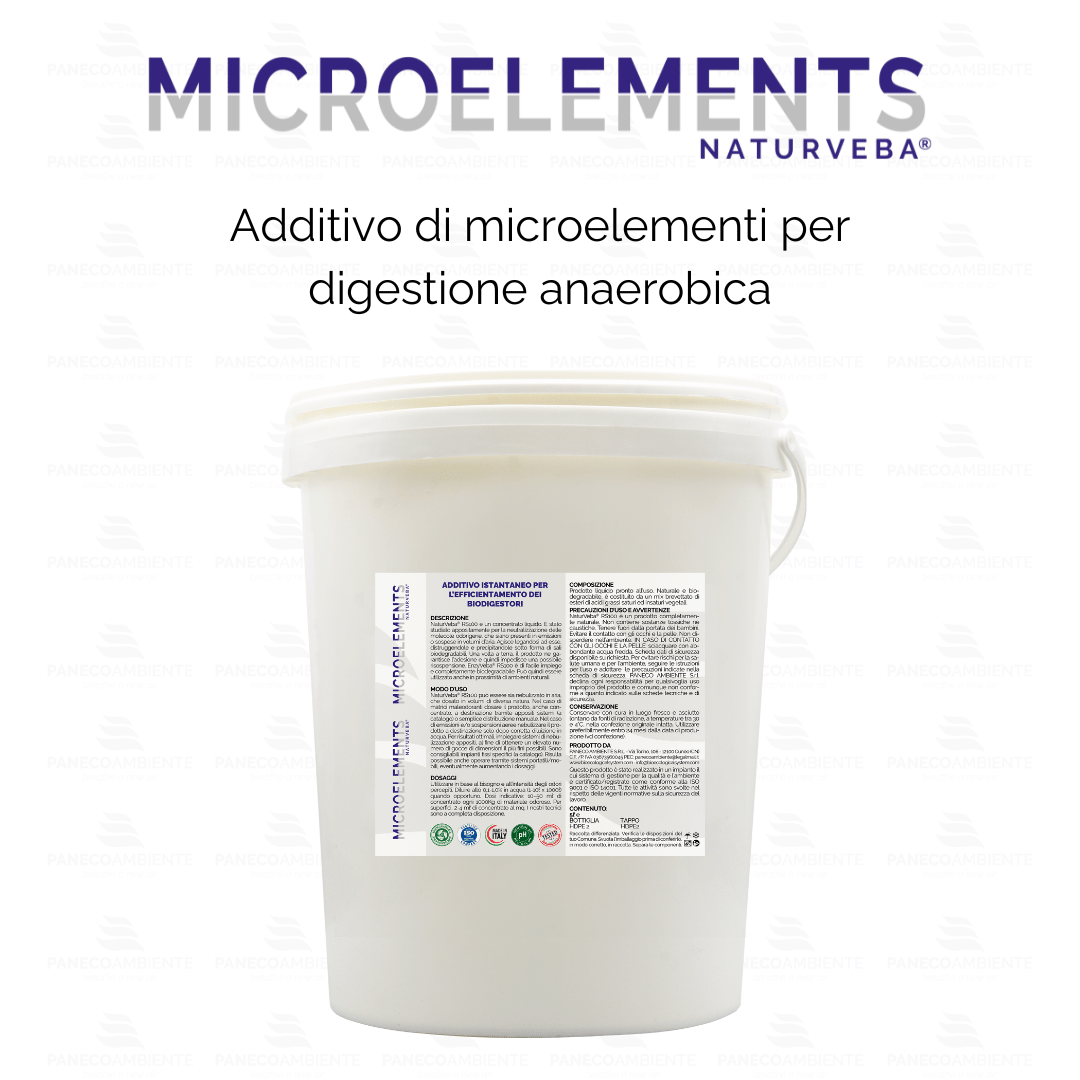
NaturVeba Microelements
Go to Product
Benefits of Bioaugmentation by Plant Type
|
Plant Type |
Typical Issue |
Solution with EnzyVeba® Biomethane |
Expected Result |
|
Small agricultural plants (<500 kW) |
Instability with seasonal wastes (straw, silage) |
Inoculation in pre-tank or feeding hopper |
+20–25% CH₄ production, reduced foaming |
|
Organic waste Digesters |
High variability of waste composition, risk of acidosis |
Automated daily dosing (50 ml/ton) |
Stable FOS/TAC < 0.4, fewer plant stoppages |
|
Intensive livestock plants |
Excess ammonia from manure inhibits methanogens |
Direct treatment with resistant archaea |
Reduced NH₃, +15–30% methane |
|
Industrial plants (>1 MW) |
Need to cut HRT to boost capacity |
Continuous bioaugmentation with Paneco Injection system |
HRT reduction by 10–15%, more fluid digestate |
|
New plant start-up |
Long microbial colonization times (4–6 months) |
Enhanced initial inoculation + weekly dosing |
Full production achieved in 6–8 weeks |
Flexible Application Methods
EnzyVeba® Biomethane can be dosed at three key points in the process:
- During matrix mixing prior to loading.
- On stored biomass (pre-treatment).
- Directly into the digester via automated systems (e.g., Paneco Injection).
The standard dose is 50 ml per ton of biomass treated daily, customizable based on digestate analysis and plant-specific operating parameters.
Operational and Economic Benefits
Introducing selected microorganisms delivers measurable advantages:
- Methane yield increase of 15–30%, reducing the need for costly substrates.
- Shorter hydraulic retention time, boosting plant throughput without structural investments.
- Control of ammonia and hydrogen sulfide, which inhibit methanogens and damage CHP engines.
- Improved digestate fluidity, lowering mixing time and energy consumption.
- Fast recovery from stress: synergy between hydrogen-producing bacteria and methanogenic archaea sustains up to +30% methane production even under heavy load conditions.
A significant case study involves an 836 kW biogas plant fed with 20 m³/day of cattle slurry, 56 tons/day of manure, and 8 tons/day of by-products. A daily treatment with just 5 liters of EnzyVeba® Biomethane produced stable methane increases while reducing the use of expensive feedstocks.
When Bioaugmentation Is Strategic
Bioaugmentation is not a “one-size-fits-all” approach but a targeted strategy suited for specific scenarios:
- New plant start-up: accelerates microbial colonization and reduces commissioning time.
- Feedstock change: when switching from one substrate to another (e.g., maize to agro-industrial residues), native microbes may take weeks to adapt.
- Difficult biomass management: straw, pruning waste, and lignocellulosic residues need enhanced hydrolytic communities.
- Inhibition recovery: high ammonia or VFA accumulation requires rapid intervention to prevent shutdowns.
EnzyVeba® Biomethane is especially effective in digesters processing heterogeneous matrices (mixes of FORSU, sludge, and livestock residues) or those seeking economic optimization by reducing purchases of energy-rich biomasses.
Safety, Certifications, and Sustainability
The product is 100% natural, biodegradable, and non-GMO.
Manufacturing complies with ISO 9001:2015 and ISO 14001:2015 standards.
Scientific studies were conducted by the University of Eastern Piedmont, the University of Turin, and Sapienza University of Rome.
It is non-toxic, non-flammable, and safe to handle, ensuring operational safety for plant staff.
Paneco Ambiente also provides ongoing technical consultancy, calibrating dosages based on biological analyses of the digester and the specific characteristics of the treated substrates to maximize efficiency.
Conclusions
Bioaugmentation represents the evolution of biogas plant management—from a passive approach (“wait and let nature take its course”) to an active, data-driven one.
By leveraging selected microorganisms and continuous monitoring (FOS/TAC, VFA, microbiome), operators can maximize efficiency and stability.
EnzyVeba® Biomethane embodies this philosophy, delivering a scientifically validated, Italian-made solution that turns any digester into a high-efficiency microbial ecosystem.